Type comparison
Gripsters with or without vibration: What does it add?
Is the built-in tile vibrator worth it? Based on 19 versus 463 models.
With vibration
19 models · median €77 · 250 kg
Without vibration
463 models · median €69 · 200 kg
The data at a glance
| With vibration | Without vibration | |
|---|---|---|
| Number of models | 19 | 463 |
| Price (median) | €77 | €69 |
| Price range | €17 to €249 | €17 to €500 |
| Capacity (median) | 250 kg | 200 kg |
| Highest load capacity | 500 kg | 500 kg |
| Capacity per €100 (median) | 440 kg | 320 kg |
| Share with USB-C | 0% | 14% |
| Share with removable battery | 95% | 38% |
| Share with digital display | 37% | 71% |
| Share with vibration | 100% | 0% |
| Share with automatic re-pump | 0% | 29% |
| Share with foam seal | 21% | 13% |
| Share with rubber seal | 79% | 85% |
| Share of branded models | 47% | 32% |
Price distribution
Line: range, bar: middle half, dot: median (per lifter)
Capacity distribution
Line: range, bar: middle half, dot: median
Price and capacity
Each dot is a model. Top left are the lifters with a lot of capacity for little money.
With vibrationWithout vibration
Features compared
With vibrationWithout vibration
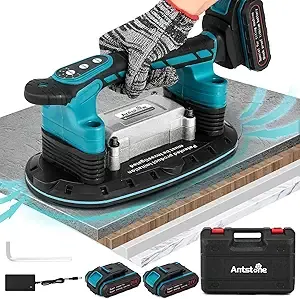
A vacuum lifter with a vibration function does more than lift the tile: once the tile is set down, it also vibrates it into the adhesive bed. This comparison puts 19 electric models with a built-in vibrator up against 463 electric gripsters without this function, leaving manual lifters out. The data shows that the extra cost of vibration is small, but the units differ clearly in design, battery system and indicator.
The difference at a glance
- Price: Vacuum lifters with vibration cost a median of €77, electric models without vibration €69. The typical premium is around €8.
- Load capacity: The vibrating models have a median rating of 250 kg, the other electric vacuum lifters 200 kg. No load capacity rating with vibration is below 200 kg.
- Design: All 19 models with vibration have an oval suction plate. Without vibration, 53% are oval, 36% round and 11% narrow.
- Battery: 95% of the vibrating models use a removable battery, and several accept batteries from common 18 V and 20 V power tool systems. None of the models offers USB-C charging.
- Convenience: None of the vacuum grippers with vibration has automatic re-pump. Without vibration, 29% of electric models have it.
What the data shows
The vibration function is a niche: only 4% of all 519 offers in the database have a built-in vibrator. Even so, the 19 models are spread widely in price. The range runs from €17 to €249, and without vibration from €17 to €500. So at the lower end both groups are equally cheap, while at the top there is more headroom without vibration, because that group also includes expensive specialty units.
On load capacity, the vibrating models come out ahead. Their median of 250 kg clearly beats the 200 kg of the comparison group, and the weakest rating with vibration is 200 kg, compared with 27 kg without. The strongest model in the entire database, a 3-in-1 unit from YEARTOP rated at 500 kg, is also one of the vibrating models. Converted to load capacity per euro, that works out to a median of 441 kg per €100 versus 321 kg without vibration. One reason is the design: across the entire database, oval gripsters have a median rating of 260 kg, round ones 200 kg.
The features around battery and indicator differ markedly. 95% of the vibrating models rely on a removable battery, compared with 38% without vibration, where 32% have a built-in battery instead. As for the indicator, the simple LED indicator dominates with vibration at 58%, while 71% of units without vibration have a digital display for the vacuum. A foam seal is found on 21% of the vibrating models and on 13% of the other models.
The share of brands is striking. 47% of vacuum lifters with vibration carry a brand name, compared with 32% without vibration. The most frequent names are Antstone, SEESII, JUYLTOOL, Raizi, XUNTOP and YEARTOP. All models with vibration are made in China. You can find an overview of all units in this group under Vacuum lifters with vibration function, and sorted by price in the ranking Cheapest with vibration.
Strengths of vacuum grippers with a vibration function
The main advantage shows when laying tiles. The vibrator settles the tile evenly into the adhesive bed, forces air out of the mortar and improves coverage on the back of the tile. With large-format tiles in particular, this helps prevent voids and makes leveling easier. Instead of working with a rubber mallet and a beating block, you keep the tile on the unit until it sits correctly. The guide Vibrating tiles into place with a vibration function describes how this works in practice.
- Lifting, positioning and vibrating with one unit
- High load capacity ratings: median 250 kg, minimum 200 kg
- Removable battery on 95%, often compatible with power tool batteries you already own
- Good ratio of load capacity to price, with a median of 441 kg per €100
If you already own batteries from a major power tool system, you can use them directly with several models. That lowers the total cost, because you do not have to buy a new battery and charger. When you buy, check whether a battery is included or whether the unit comes as a bare tool.
Strengths of gripsters without a vibration function
Without a vibrator, the selection is far larger: 463 electric models in every design, from compact round suction pads to narrow lifters for trims and glass strips. If you mainly carry, lift and position, you do not need vibration and you benefit from functions that vibrating models do not offer.
- Automatic re-pump on 29% of models, which tops up the vacuum on its own when it drops
- USB-C charging on 14%, handy on job sites without power tool batteries
- Digital display for the vacuum on 71%
- Round and narrow designs for glass, trims and smaller formats
- Simpler construction without an additional vibration motor
Automatic re-pump adds safety when carrying over longer distances: if the vacuum drops, the pump starts before holding force falls to a critical level. A digital display lets you read the state of the vacuum precisely, while an LED indicator only reports levels. The comparison Removable battery vs. USB-C shows what role the battery type plays.
Which type for which job?
| Application | Recommendation |
|---|---|
| Laying large-format floor tiles | With vibration |
| Wall tiles and medium formats | Either works, vibration as a convenience |
| Carrying and stacking panels | Without vibration, ideally with automatic re-pump |
| Glass, mirrors, worktops | Without vibration |
| Narrow trims and strips | Without vibration, narrow design |
For tile setters who regularly lay formats from 60 x 60 cm, a vacuum lifter with vibration, often called a gripster in the trade, is a real working tool. The guide Laying large-format tiles with vacuum grippers offers tips on handling large formats. For occasionally moving panels, glass or natural stone, an electric vacuum lifter without a vibrator is enough, and there the choice of designs and convenience features is much larger. If you need both, combine a vibrator for laying with a round gripster for transport.
For safety: the vibration is for settling a tile once it is set down, not for carrying. Check the vacuum indicator before every lift, make sure the surface is clean and dry, and only switch on the vibration once the tile is resting on the adhesive bed. The guide Working safely with vacuum lifters has more advice.
Conclusion
At around €8 at the median, the extra cost of the vibration function is small, and the vibrating models are rated strongly, with a median of 250 kg. In return, they are locked into the oval design and the removable battery and do without USB-C and automatic re-pump. For laying large tiles, the built-in vibrator is a sensible addition. For pure transport tasks, a gripster without vibration offers more choice and more safety features.
Frequently asked questions
How much more does a vacuum lifter with a vibration function cost?
Gripsters with vibration cost a median of €77, electric vacuum grippers without vibration €69. The cheapest models in both groups start at €17, and the most expensive model with vibration costs €249.
Can I also carry panels with a vibrating vacuum gripper?
Yes, these units are fully fledged gripsters with a load capacity of at least 200 kg according to the manufacturer's rating. None of the models has automatic re-pump, so you should check the vacuum indicator regularly over longer distances.
Which batteries do vacuum grippers with vibration use?
95% use a removable battery. According to their data sheets, several models are designed for batteries from common 18 V and 20 V power tool systems, while others come with their own batteries. None of the 19 models offers USB-C charging.
Why do all vibrating models have an oval suction plate?
The oval suction plate offers a large contact area on rectangular tiles and spreads the vibration over a longer distance. It also achieves high load capacities: oval vacuum grippers have a median rating of 260 kg, round ones 200 kg. Learn more in the comparison Round vs. oval.
Recommended models: With vibration
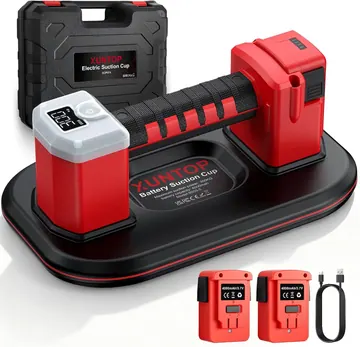
XUNTOP
XUNTOP 10-inch battery vacuum lifter with vibration function, 300 kg
300 kgOvalRemovable battery
€54
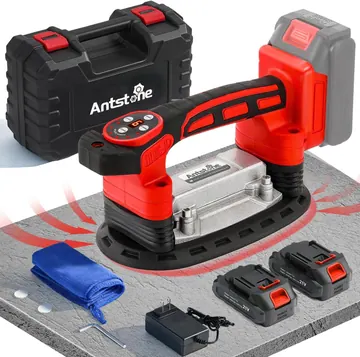
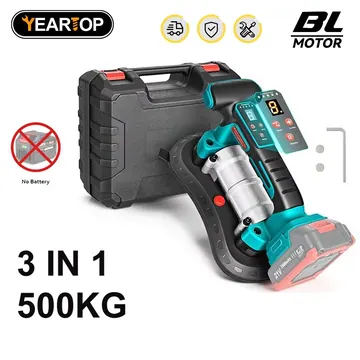
YEARTOP
YEARTOP 3-in-1 vacuum gripper with vibration for Makita battery, 500 kg
500 kgOvalRemovable battery
€249
Recommended models: Without vibration
Olubfdh
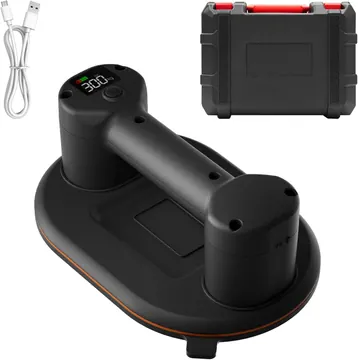
Olubfdh battery vacuum lifter, twin pack, 300 kg, 4,000 mAh
300 kgOvalBuilt-in battery
€46€23 each
SEESII
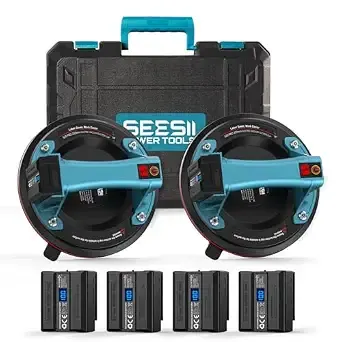
SEESII battery vacuum gripper 203 mm, twin pack with 4 batteries
272 kgØ 203 mmRemovable battery
€43€22 each
SEESII
SEESII electric 8-inch vacuum gripper, twin pack with 4 batteries
272 kgØ 203 mmRemovable battery
€43€22 each
Sundpey
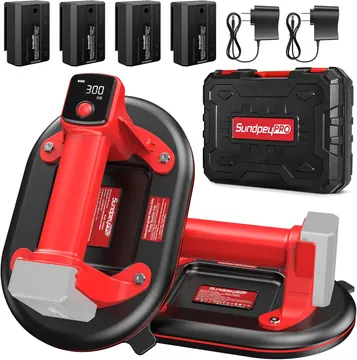
SundpeyPRO 10-inch battery vacuum lifter, twin pack, four 3 Ah batteries
300 kgOvalRemovable battery
€60€30 each