Olubfdh
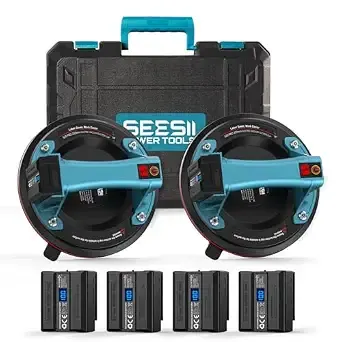
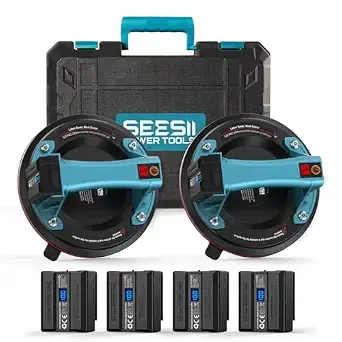
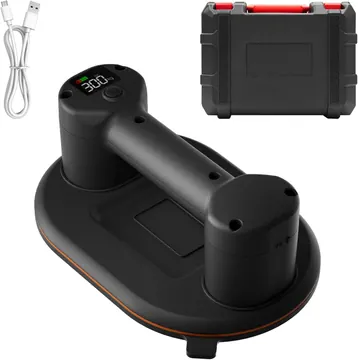
Olubfdh battery vacuum lifter, twin pack, 300 kg, 4,000 mAh
300 kgOvalBuilt-in battery
€46€23 each
Battery pump against hand pump and lever. Based on 482 versus 37 models.
482 models · median €70 · 200 kg
37 models · median €42 · 220 kg
| Electric lifters | Manual lifters | |
|---|---|---|
| Number of models | 482 | 37 |
| Price (median) | €70 | €42 |
| Price range | €17 to €500 | €12 to €195 |
| Capacity (median) | 200 kg | 220 kg |
| Highest load capacity | 500 kg | 300 kg |
| Capacity per €100 (median) | 322 kg | 759 kg |
| Share with digital display | 70% | 0% |
| Share with vibration | 4% | 0% |
| Share with foam seal | 13% | 0% |
| Share with rubber seal | 85% | 97% |
| Share of branded models | 32% | 24% |
The gripster market is clearly dominated by electric units: 482 of the 519 models in the database generate the vacuum with a battery-powered pump, and only 37 work with a hand pump or lever. Even so, manual vacuum grippers have a firm place, because they are far ahead on load capacity per euro. This comparison shows what you get for the extra cost of an electric drive and when a hand pump pays off.
Prices for manual vacuum lifters range from €12 to €195, with an average of €54. Electric models cost between €17 and €500, with an average of €92. The difference is just under €28 at the median and almost €40 on average, because electric units include a broad top tier of elaborate models.
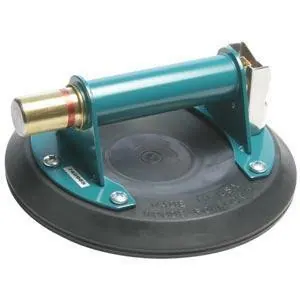
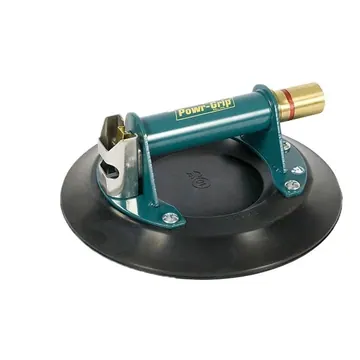
Load capacity is remarkable. Manual vacuum grippers are no weaker than electric ones at the median, and at 220 kg they are even slightly ahead. There is a simple reason: load capacity depends on the vacuum and the area of the suction plate, not on the drive. A round 8-inch pad holds the same at the same vacuum, whether the air is pumped out by hand or by a motor. Because manual units do without a battery, pump motor and electronics, they cost less, and their load capacity per €100, at 759 kg, is more than twice as high.
Electric models, on the other hand, are much better equipped. 70% show the vacuum on a digital display, 9% via LED. 28% re-pump automatically when pressure drops, and 4% offer a vibration function. As for batteries, 40% have a removable battery and 31% a built-in battery, and 14% charge via USB-C. The median battery has 3,000 mAh. Foam seals for rough surfaces are only found on electric units (13%), while 97% of manual gripsters rely on rubber.
Origin differs too. 81% of manual gripsters come from China, compared with 96% of electric ones. Among manual models, Woods Powr-Grip, Montolit, Dortech and Raizi are the most frequent names. Branded units make up 24% of manual and 32% of electric vacuum grippers.
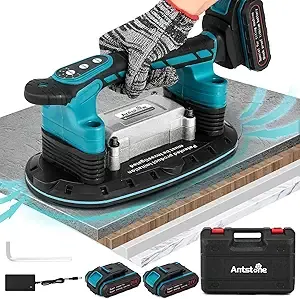
The electric vacuum lifter, often called a gripster in the trade, does the pumping for you. One press of a button is enough: the pump builds up the vacuum, a sensor measures it and the indicator shows whether you can lift. On production jobs with dozens of tiles, that saves time and effort, and your second hand stays free to guide the panel.
Automatic re-pump increases safety over longer distances and on surfaces where some air seeps back in: if the vacuum drops below a threshold, the pump starts up on its own. Combined with a foam seal, this lets you work even on rough and textured surfaces, which is hardly practical with a hand pump. Combination units with vibration also help bed large tiles into place.
Only electric vacuum lifters come with oval or narrow plates, in other words in shapes for planks, long formats and narrow parts. The strongest unit is a 3-in-1 gripster with vibration for power tool batteries, with a 500 kg rated load, for €249. The best value relative to load capacity is a battery-powered vacuum gripper with a 203 mm pad, sold as a twin pack, at €17 per unit and rated at 272 kg.
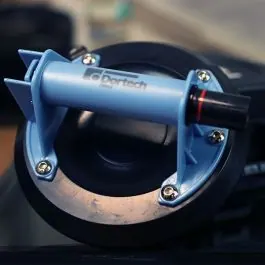
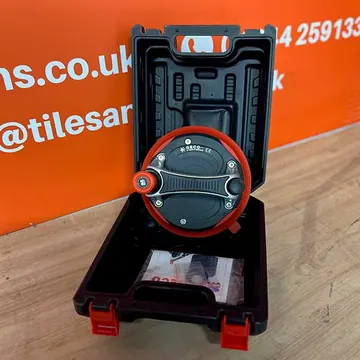
Manual vacuum lifters are simple, rugged and always ready to use. There is no battery that can run flat or age, and no electronics to suffer from dust, moisture or tile adhesive. On pump-style gripsters, a red mark on the pump plunger shows the status: it disappears when there is enough vacuum and reappears when the vacuum weakens. A few strokes are then enough to pump it back up.
On price, manual units are hard to beat. The cheapest model in the entire database is a hand pump twin pack with a carrying case for €12 per unit, rated at 220 kg. The strongest manual model, an 8-inch set with a pressure gauge, is rated at 300 kg and costs €18 per unit. Because manual vacuum grippers are often sold in pairs, they are well suited to carrying with both hands.
| Application | Recommendation | Reason |
|---|---|---|
| Wall tiles, occasional use | manual | low cost, no battery needed |
| Large formats in volume | electric with automatic re-pump | less effort, vibration available |
| Wood-look tiles | electric, oval or narrow | manual pads are too wide for narrow planks |
| Glass | manual or electric with rubber seal | smooth surface, both hold reliably |
| Stone worktops | electric with digital display | vacuum always in view while carrying |
| Rough patio slabs | electric with foam seal | a hand pump can hardly make up for leaks |
| Stair treads | manual for wide treads, narrow electric for narrow parts | design depends on the width |
Large formats carried by two people require several vacuum lifters. Learn more in the guide Laying large-format tiles. The guide How does an electric vacuum gripper work? describes how the electric pump and the sensor work together.
Whatever the drive: keep surfaces clean, check the indicator or the mark on the plunger before every lift and first raise the load only a few centimeters. If the vacuum holds, you can carry it.
Electric gripsters offer convenience, monitoring and versatility: digital displays, automatic re-pump, foam seals and oval or narrow plates are only available here. Manual vacuum grippers hold just as much at the median but cost considerably less: you get more than twice as much load capacity per euro, plus independence from batteries and simple maintenance. If you occasionally move tiles, glass or smooth panels, a manual pair will equip you well. If you lay tiles every day or work with large formats or rough surfaces, you will benefit from an electric drive. You can find all models under Manual vacuum lifters and Battery vacuum lifters.
Not inherently. Safety depends on the vacuum being monitored. On manual pump-style gripsters, the red mark on the plunger does this job, on electric ones the indicator. One advantage of electric units is automatic re-pump, which compensates for a creeping loss of pressure on its own.
Because load capacity depends on the vacuum and the plate area, not on the drive. Manual units reach a median of 220 kg but, without a battery, motor and electronics, cost only €42. That gives them 759 kg per €100, compared with 322 kg for electric models.
On pump-style gripsters, a red mark becomes visible on the plunger as soon as the vacuum drops. You should then set the load down or pump it back up immediately. Some manual models also have a pressure gauge that shows the vacuum as a value.
For one-off projects with smooth tiles, a manual pair is usually enough. An electric unit pays off with large formats, many tiles in one go, wood-look planks or rough surfaces. The buying guide Finding the right vacuum gripper helps you choose.