SEESII
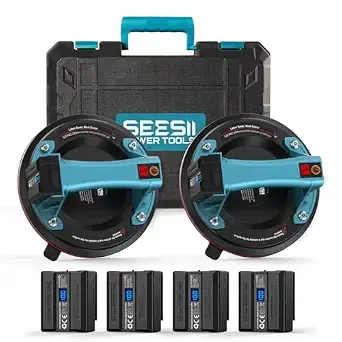
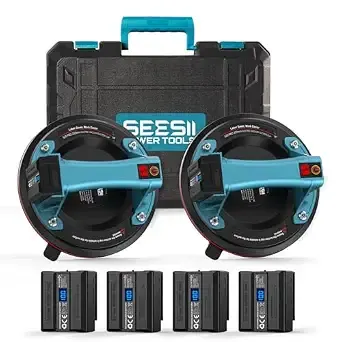
SEESII battery vacuum gripper 203 mm, twin pack with 4 batteries
272 kgØ 203 mmRemovable battery
€43€22 each
Swap the battery or charge by cable: what works better on the job. Based on 194 versus 60 models.
194 models · median €69 · 220 kg
60 models · median €70 · 200 kg
| Removable battery | Built-in battery with USB-C | |
|---|---|---|
| Number of models | 194 | 60 |
| Price (median) | €69 | €70 |
| Price range | €17 to €500 | €20 to €256 |
| Capacity (median) | 220 kg | 200 kg |
| Highest load capacity | 500 kg | 300 kg |
| Capacity per €100 (median) | 368 kg | 290 kg |
| Share with USB-C | 3% | 100% |
| Share with removable battery | 100% | 0% |
| Share with digital display | 60% | 83% |
| Share with vibration | 9% | 0% |
| Share with automatic re-pump | 21% | 27% |
| Share with foam seal | 14% | 20% |
| Share with rubber seal | 85% | 78% |
| Share of branded models | 40% | 18% |
On electric vacuum lifters, often called gripsters in the trade, the battery concept shapes how your working day goes: swap the battery and keep working, or charge the unit by cable and plan a break. In the database, 194 models have a removable battery and 60 models a built-in battery charged via USB-C. On price, the two are level, but they differ clearly in load capacity, features and typical use.
Prices for removable battery models range from €17 to €500, with an average of €104. USB-C models cost between €20 and €256, with an average of €77. With the medians level, the higher average shows that the removable battery group includes a top tier of expensive units: combination units with vibration and a high rated load, often designed for batteries from 18-volt power tool systems.
On load capacity, the removable battery is slightly ahead, and on value for money clearly so: 368 kg versus 290 kg per €100. One reason is the price structure. On units for power tool batteries, the battery is often not included in the price, and low-cost twin packs also push the price per unit down. The best-value model relative to load capacity is a battery-powered vacuum gripper with a 203 mm pad, sold as a twin pack, at €17 per unit and rated at 272 kg.
The designs are distributed similarly in both groups: 52% of each are oval, 37% (removable battery) and 42% (USB-C) are round, and the rest are narrow. 14% and 20% respectively have a foam seal. Automatic re-pump is slightly more common on USB-C units (27% versus 21%). Branded units account for 40% of removable battery models and 18% of USB-C models. Incidentally, the two concepts are not entirely mutually exclusive: 3% of removable battery units also charge their battery via USB-C.
A technical note helps when comparing battery sizes. Milliamp hours are only comparable at the same voltage, and the stored energy is voltage multiplied by capacity. A 3.7 V lithium-ion cell with 2,000 mAh stores around 7.4 Wh, an 18-volt power tool battery with 2,000 mAh around 36 Wh. Where manufacturers state watt hours, that is the more meaningful figure.
The biggest advantage is that there is no charging break. When the battery is empty, you swap it in seconds and keep working. That matters above all on production jobs where the vacuum lifter is placed again and again for hours.
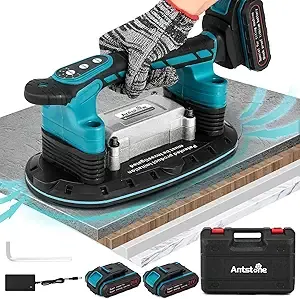
Many removable battery models use batteries from common 18-volt power tool systems. If you already own cordless drills or angle grinders from such a system, you can keep using your existing batteries and chargers. When a battery ages, you only replace the battery, not the whole unit.
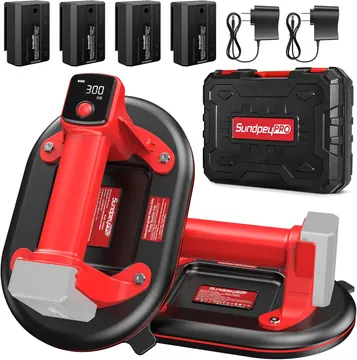
This group is also the more powerful one: only here will you find models with a 500 kg rated load and a vibration function, for example a 3-in-1 unit for power tool batteries rated at 500 kg for €249. The cheapest unit, a battery-powered tile vibrator with a 30 x 16 cm suction plate, costs €17. With offers like these, check what is included, because units designed for power tool batteries are often sold without a battery and charger.
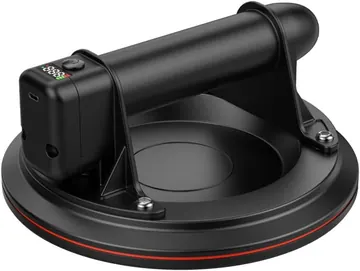
A built-in battery with a USB-C port charges from almost any power source: a phone charger, a power bank, the vehicle. You do not need a dedicated charger, and one cable is enough for your vacuum lifter, phone and laser level. The housing is sealed, with no battery compartment and no exposed contacts for dust or tile adhesive to get into.
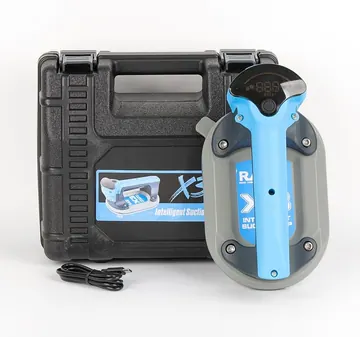
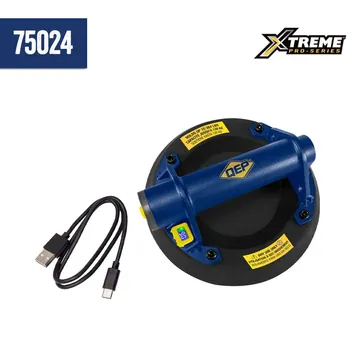
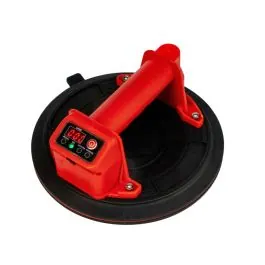
USB-C models are also more often equipped with a digital display (83%) and are compactly built, because there is no battery pack on the handle. The cheapest unit with a built-in battery and USB-C costs €20 with a 200 kg rated load, and the strongest is a 10-inch vacuum gripper with an LCD and 4,000 mAh, rated at 300 kg and costing €256.
The drawback is obvious: when the battery is empty, the unit is out of action until it has recharged. If you only work occasionally or have a second unit, you will hardly notice this.
| Application | Recommendation | Reason |
|---|---|---|
| Wall tiles, occasional use | USB-C | compact, charges from any power adapter |
| Large formats, full working day | Removable battery | no charging break, vibration available |
| Wood-look tiles in volume | Removable battery | many placements, swappable battery |
| Glass | USB-C | often with digital display, no battery compartment |
| Stone worktops | either | few lifts per job, indicator matters more than runtime |
| Patio slabs with a rough surface | Removable battery | pump runs more often due to leaks |
| Stair treads | either | small quantities, design matters more than battery |
How much energy a gripster uses depends less on the weight of the panel than on how often the pump runs. It works when building up suction and when re-pumping. On smooth surfaces with a rubber seal, it hardly ever has to re-pump, but on rough surfaces with a foam seal and active automatic re-pump, it runs much more often. Learn more in the guide Battery and charging and in the explainer How does an electric vacuum gripper work?.
For safety, the same applies to both concepts: fully charge before larger jobs and do not lift heavy panels with an almost empty battery.
At the same price, the removable battery offers more load capacity per euro, a wider choice of powerful units and, above all, constant readiness for use. It is the first choice for professionals and anyone who already uses an 18-volt power tool system. The built-in battery with USB-C scores with easy charging, a sealed housing and a more frequent digital display, and suits anyone who uses their vacuum lifter occasionally or as a second unit. The rankings Cheapest with removable battery and Cheapest with USB-C show the lowest-priced models in both groups.
With many vacuum grippers with a removable battery, yes, provided the unit is designed for your battery system. Check the exact system designation and the voltage, usually 18 volts. Units like these are often sold without a battery, which explains the low entry price.
That depends mainly on how often the pump runs. On smooth surfaces with a tight rubber seal, a charge lasts much longer than on rough surfaces with constant automatic re-pump. The median battery has 2,400 mAh on removable battery models and 2,000 mAh on built-in batteries.
On most units, a check valve holds the vacuum even without the pump, but there is no more re-pumping. So set the panel down immediately when the low-battery warning appears, and watch the indicator. The guide Working safely with vacuum grippers explains how to work safely.
Yes, but they are rare: 3% of removable battery models charge their battery via USB-C. This combination pairs fast swapping with easy charging from a phone charger. You can find all models with a USB-C port under Charging via USB-C.