SEESII
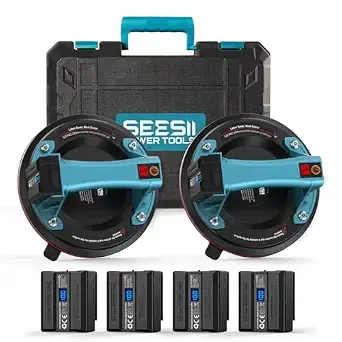
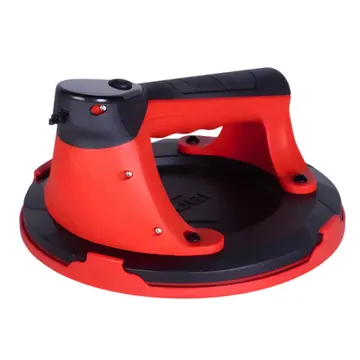
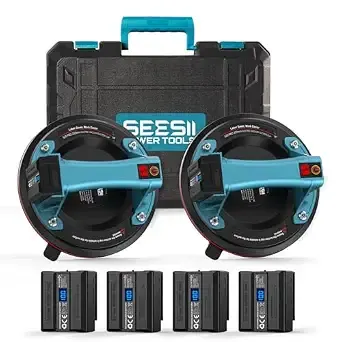
SEESII battery vacuum gripper 203 mm, twin pack with 4 batteries
272 kgØ 203 mmRemovable battery
€43€22 each
How much more capacity does the larger pad bring? Based on 119 versus 5 models.
119 models · median €55 · 220 kg
5 models · median €92 · 150 kg
| 8 inch (approx. 200 mm) | 10 inch (approx. 250 mm) | |
|---|---|---|
| Number of models | 119 | 5 |
| Price (median) | €55 | €92 |
| Price range | €17 to €216 | €31 to €195 |
| Capacity (median) | 220 kg | 150 kg |
| Highest load capacity | 300 kg | 260 kg |
| Capacity per €100 (median) | 487 kg | 146 kg |
| Share with USB-C | 19% | 25% |
| Share with removable battery | 68% | 25% |
| Share with digital display | 51% | 60% |
| Share with automatic re-pump | 26% | 50% |
| Share with rubber seal | 98% | 100% |
| Share of branded models | 42% | 80% |
Round vacuum lifters come mainly in two sizes: 8 inches, at around 200 mm, and 10 inches, at around 250 mm in diameter. The 8-inch pad is the clear standard, with 119 models in the database in this size. Larger round pads are rare: the comparison group includes only 5 models from 220 to 254 mm. This page explains what the data shows and what the larger area does in physical terms.
8-inch vacuum lifters cost between €17 and €216, with a median of €55. One reason is that 27% of these offers are twin packs, which bring the price per unit down considerably. The larger pads cost between €31 and €195, with a median of €92. The cheapest model in the group, an AUCOGIA gripster with a 254 mm pad for €31, is also the strongest: the manufacturer rates it at 260 kg. At the top end is a manual lever vacuum gripper from Montolit for €195.
At 8 inches, ratings range from 57 to 300 kg, with a median of 220 kg. In the 10-inch group, only three of the five models state a load capacity: 260 kg, 150 kg and 125 kg. The two lower figures come from 220 mm pads made by the tile tool brands Rubi and Montolit. The 150 kg median therefore says more about how individual manufacturers rate their products than about pad size. The spread at 8 inches shows the same thing: with almost identical area, the ratings differ by a factor of more than five.
Converted to load capacity per euro, 8-inch models reach a median of 487 kg per €100, the larger ones 146 kg. This figure, too, mainly reflects the few branded units in the larger group, some of them high-priced.
78% of 8-inch vacuum grippers are electric, the rest work with a hand pump. Of the electric models, 68% have a removable battery, 23% a built-in battery and 19% USB-C charging. Among the larger pads, four out of five models are electric and one is a mechanical lever vacuum lifter. Built-in batteries dominate here, and two of the four electric units have automatic re-pump. Rubber seals are used almost exclusively in both groups. The share of branded models is 42% at 8 inches, while four out of five models in the larger group carry a brand name.
A vacuum lifter holds because the outside air pressure presses the panel against the pad. The holding force is the vacuum under the pad multiplied by the effective area. Area grows with the square of the diameter: 25% more diameter means around 56% more area.
| Diameter | Area | Calculated per 0.1 bar | Calculated at 0.8 bar |
|---|---|---|---|
| 203 mm (8 inches) | 324 cm² | around 33 kg | around 264 kg |
| 220 mm | 380 cm² | around 39 kg | around 310 kg |
| 254 mm (10 inches) | 507 cm² | around 52 kg | around 413 kg |
The values refer to the full outside diameter. The effective area is the area inside the sealing lip, which is somewhat smaller, but the ratio between the sizes stays the same. A load capacity rating should be well below the calculated value, leaving a safety margin for tilting, vibration and a slowly dropping vacuum. Ratings of 270 to 300 kg at 8 inches come close to what the area can deliver. Learn more in the guide Assessing load capacity correctly and in the explainer How does an electric vacuum lifter work?.
A second effect: a larger pad encloses more air volume. A small leak at the sealing lip therefore tends to make the vacuum drop more slowly, and the load is spread over a larger contact area.
The 8-inch vacuum lifter, often called a gripster in the trade, is the all-round format for tiles, glass and panels. If you need more area, combine two units: two 8-inch pads together give around 648 cm² of suction area, more than a single 10-inch pad. The comparison Single unit vs. twin pack shows what such sets cost. You can find all models in this size under 8 inches (approx. 200 mm).
The larger area pays off wherever a single lifter has to hold a lot of weight securely, for example with worktops, window sills or stair treads. The guide Moving natural stone and worktops has advice on loads like these. The few models in this size are listed under 10 inches (approx. 250 mm).
| Application | Recommendation |
|---|---|
| Tiles up to about 60 x 60 cm | 8 inches |
| Large formats from 120 cm in length | Two 8-inch lifters or oval gripsters |
| Heavy natural stone slabs | 10 inches or several lifters |
| Glass panes and mirrors | 8 inches, 10 inches for heavy panes |
| Small cut pieces and strips | 8 inches or a narrow design |
If you are looking for more area, oval suction plates are the main alternative to round 10-inch pads. With 265 models they are far more numerous, and their median rating is 260 kg. Very large formats should always be carried by two people using at least two lifters.
In physical terms, the larger pad has a clear advantage: around 56% more area means around 56% more holding force at the same vacuum. The load capacity ratings in the database do not reflect this, because the 10-inch group includes only five models and two of them are rated very conservatively. For most jobs, the 8-inch vacuum gripper is the economical choice, with a wide selection and a median price of €55. A 10-inch pad pays off for heavy single loads where one lifter needs the full margin.
At the same vacuum, yes: the area of a 254 mm pad is around 56% larger than that of a 203 mm pad, and holding force rises in the same proportion. The 10-inch group's median rating of 150 kg comes down to a few conservative manufacturer's ratings.
The market has settled on 8 inches as the standard, with 119 models in this size. If you need more area, you will usually reach for oval suction plates, which form the largest segment with 265 models.
For large panels, often yes. Two 8-inch pads have a combined area of around 648 cm², a 10-inch pad around 507 cm². Two lifters also spread the load over two points, so long panels sag less.
The surface must be clean, dry and flat enough for the sealing lip to sit flush all the way around. The larger the pad, the more unevenness the seal has to bridge. Check the vacuum indicator before you lift.