SEESII
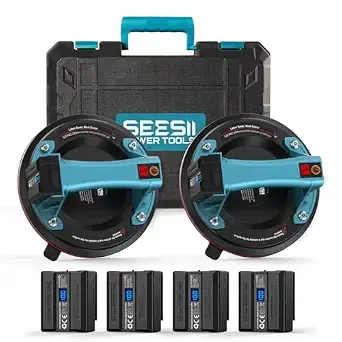
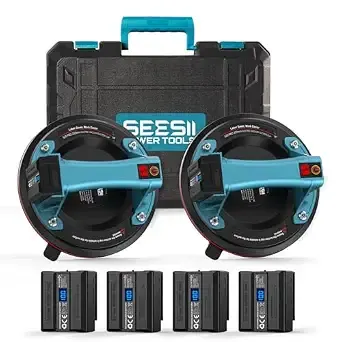
SEESII battery vacuum gripper 203 mm, twin pack with 4 batteries
272 kgØ 203 mmRemovable battery
€43€22 each
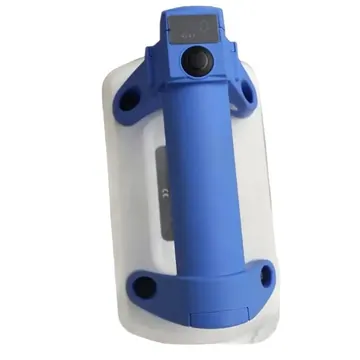
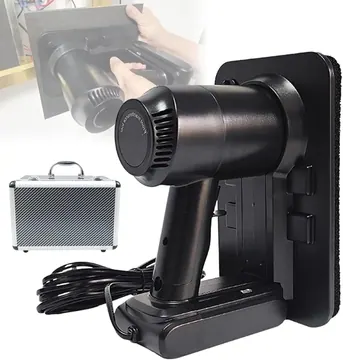
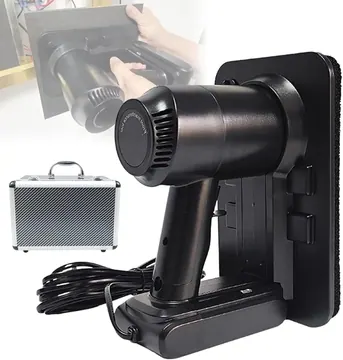
Large round pad against a compact rectangular plate. Based on 200 versus 51 models.
200 models · median €60 · 200 kg
51 models · median €95 · 100 kg
| Round lifters | Narrow lifters | |
|---|---|---|
| Number of models | 200 | 51 |
| Price (median) | €60 | €95 |
| Price range | €12 to €339 | €23 to €407 |
| Capacity (median) | 200 kg | 100 kg |
| Highest load capacity | 300 kg | 300 kg |
| Capacity per €100 (median) | 347 kg | 148 kg |
| Share with USB-C | 19% | 8% |
| Share with removable battery | 43% | 43% |
| Share with digital display | 54% | 31% |
| Share with automatic re-pump | 28% | 24% |
| Share with foam seal | 0% | 61% |
| Share with rubber seal | 98% | 29% |
| Share of branded models | 34% | 20% |
With 200 models, round gripsters are the classic design, while narrow vacuum grippers with a rectangular suction plate form a niche of 51 models. The two solve different tasks: the round pad puts a lot of area on smooth panels, and the narrow plate fits where a pad would overhang. The data shows clear differences in price, load capacity and seal, and they are easy to explain technically.
Prices for round vacuum grippers range from €12 to €339, with an average of €68. Narrow models cost between €23 and €407, with an average of €132. Because the group of narrow units is small, a few expensive models pull the average well above the €95 median.
On load capacity, round gripsters are clearly ahead: 200 kg at the median versus 100 kg. The weakest narrow unit is rated at 27 kg, the weakest round one at 57 kg. The reason lies in the geometry. Holding force is the vacuum multiplied by the effective area inside the seal, and on a narrow plate a larger share of the area is lost to the seal rim. A worked example with a 1 cm wide seal: a round pad with a 203 mm diameter covers 324 cm², of which around 263 cm² inside remains effective, about 81%. A 30 x 8 cm rectangular plate covers 240 cm², but only 28 x 6 cm is effective, 168 cm² or 70%. Less area and a higher share taken up by the rim mean much less load capacity at the same vacuum.
The seal adds to this. Foam gives way and conforms to textures, but never seals quite as tightly as a rubber lip. Manufacturers therefore usually give lower rated loads for foam models.
The features show further differences. A removable battery is equally common in both groups (43% of electric models), while a built-in battery is more common on round units (31% versus 16%). 19% of electric round and 8% of narrow vacuum grippers charge via USB-C. 28% and 24% respectively have automatic re-pump. The median battery is the same size, at 2,400 mAh. Twin packs are only available among round models (19%), and the share of branded units is higher among round ones (34% versus 20%).
Round vacuum lifters offer the most load capacity for the money. At 347 kg per €100, they are the most economical of the three designs, and at €12 per unit, the cheapest model in the entire database comes from this group, a hand pump twin pack with a 220 kg rated load. The strongest round model, a battery-powered gripster with a 203 mm pad and pressure gauge in a twin pack, is rated at 300 kg according to its data sheet and costs €50 per unit.
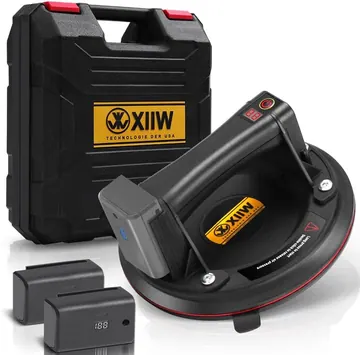
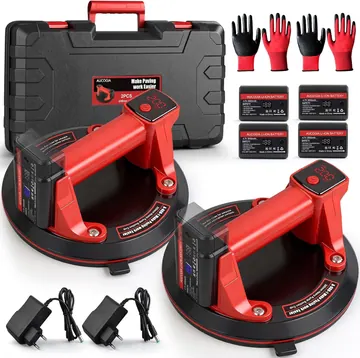
The round pad does not care about orientation and can be placed quickly. On smooth surfaces such as glass, glazed ceramics and polished natural stone, the rubber seal closes almost airtight. If you want to work without a battery, you will also find manual models here, which at 17% make up a noticeable part of the group.
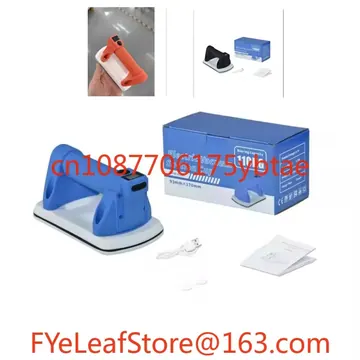
Narrow vacuum grippers play to their strengths where round pads do not fit. An 8-inch pad needs a width of at least a good 20 cm for the seal to sit fully. A narrow plate sits securely on 15 cm wide wood-look tiles, on edge strips along the wall, on window sills and on stair risers.
The frequent foam seal is not a drawback but intentional: on wood grain, grooves and textured surfaces, a rubber lip would draw air. The foam presses into the recesses and holds the vacuum where rubber fails. So what you get for the extra cost compared with round units is not load capacity, but fit and grip on difficult surfaces.
The range within the group is wide. The cheapest narrow unit, an electric gripster with a foam pad and a 100 kg rated load, costs €23. The strongest, which is also the best value relative to load capacity, is a battery-powered vacuum gripper rated at 300 kg with 4,000 mAh and automatic re-pump for €37.
| Application | Recommendation | Reason |
|---|---|---|
| Wall tiles | round | handy, large margin, low-cost as a pair |
| Large formats from 60 x 120 cm | round, in pairs | more load capacity, narrow units have too little margin |
| Wood-look tiles under 20 cm wide | narrow | a pad would overhang |
| Wood-look with deep texture | narrow with foam seal | seals into grooves and grain |
| Glass | round with rubber seal | smooth surface, even sealing lip |
| Stone worktops | round, two or more units | heavy load, load distribution |
| Porcelain stoneware patio slabs | round | smooth surface, high load capacity |
| Rough concrete slabs | narrow with foam seal | rubber loses vacuum on rough surfaces |
| Stair treads and window sills | narrow | fits on narrow parts and risers |
For large formats, an oval plate is often a good fit too, as it offers more area than a round pad: see Round vs. oval. If you are torn between foam and rubber, you will find the details in the comparison Rubber vs. foam and in the Surface guide.
With narrow vacuum grippers, a test run makes particular sense: place the unit, build up the vacuum and watch the indicator for a minute. If the value drops, the seal does not close reliably on this surface.
Round and narrow vacuum grippers hardly compete with each other: they complement each other. The round vacuum lifter, often simply called a gripster in the trade, is the economical standard tool for smooth tiles, glass and heavy panels. The narrow vacuum lifter is a specialty tool for narrow formats and textured surfaces: more expensive and with less load capacity, but usable where a pad will not hold. If you regularly need both, you are best off with a pair of round units and one narrow model. You can find an overview of all models with a rectangular plate under Narrow vacuum lifters.
Because the effective area is smaller. Holding force grows with the area inside the seal, and on a narrow plate a larger share is taken up by the seal rim. On top of that comes the frequent foam seal, which seals less tightly. At the median, narrow models hold 100 kg, round ones 200 kg.
They are a niche product with a smaller selection: 51 models versus 200 round ones. The median price is €95 versus €60. What you mainly pay for is the fit for narrow formats and the foam seal for textured surfaces, not extra load capacity.
On slightly textured, matte tiles, usually yes, but on deep wood grain, grooves or rough surfaces, often not. The rubber lip then does not make full contact, and air seeps in through the recesses. There are no round models with a foam seal in the database, so narrow or oval units with foam are the answer here.
For the weight of the tile, easily: a 20 x 120 cm porcelain stoneware plank 10 mm thick weighs just under 6 kg. The margin still matters, because lifting a tile out of fresh mortar takes considerably more force than its own weight. Learn more in the guide Assessing load capacity correctly.