Type comparison
One battery vs. two batteries: Is a spare battery worth it?
Is a spare battery in the box worth it? Based on 47 versus 69 models.
One battery
47 models · median €69 · 200 kg
Two batteries
69 models · median €50 · 272 kg
The data at a glance
| One battery | Two batteries | |
|---|---|---|
| Number of models | 47 | 69 |
| Price (median) | €69 | €50 |
| Price range | €29 to €310 | €22 to €472 |
| Capacity (median) | 200 kg | 272 kg |
| Highest load capacity | 300 kg | 400 kg |
| Capacity per €100 (median) | 297 kg | 571 kg |
| Share with USB-C | 53% | 1% |
| Share with removable battery | 32% | 97% |
| Share with digital display | 79% | 75% |
| Share with vibration | 2% | 9% |
| Share with automatic re-pump | 28% | 26% |
| Share with foam seal | 15% | 9% |
| Share with rubber seal | 83% | 91% |
| Share of branded models | 26% | 67% |
Price distribution
Line: range, bar: middle half, dot: median (per lifter)
Capacity distribution
Line: range, bar: middle half, dot: median
Price and capacity
Each dot is a model. Top left are the lifters with a lot of capacity for little money.
One batteryTwo batteries
Features compared
One batteryTwo batteries
On electric vacuum grippers, the battery determines how long you can work without a break. This comparison puts 47 battery-powered vacuum lifters supplied with one battery up against 69 units with two or more batteries. The data shows a clear pattern: the number of batteries is closely tied to the battery system, and the spare battery does not make the unit more expensive. At the median, it actually makes it cheaper.
The difference at a glance
- Price: Vacuum lifters with two batteries cost a median of €50 per unit, with one battery €69.
- Battery system: 97% of units with two batteries use a removable battery. With one battery, it is built in 68% of the time.
- Charging: 53% of units with one battery charge via USB-C, while among units with two batteries only one of 69 models does.
- Load capacity: With two batteries the median is 272 kg, with one battery 200 kg.
- Capacity: The single battery has a median of 2,000 mAh, while on units with two batteries each battery has 2,400 mAh.
What the data shows
The comparison splits battery-powered gripsters into two concepts. On one side are compact units with a built-in battery that charge via USB-C. On the other are removable battery systems that come with a second battery. The split is clear: only 3% of units with two batteries have a built-in battery. Conversely, 32% of units with one battery already use a removable battery that can later be supplemented with a second one.
On price, the two-battery group comes out ahead. Per unit, it costs a median of €50 versus €69, and an average of €67 versus €77. One reason: 43% of the two-battery offers are twin packs, which bring the price per unit down. In these sets, two vacuum grippers share the batteries, one or two per unit depending on the offer. The cheapest unit with several batteries costs €22 apiece, the cheapest with one battery €29.
The two-battery group also has higher load capacity ratings: a median of 272 kg, with a range of 200 to 400 kg. With one battery, the values range from 90 to 300 kg, with a median of 200 kg. Per €100, that works out to 571 kg versus 297 kg. The strongest unit with two batteries is a tile vibrator from Antstone with a 283 mm suction pad rated at 400 kg for €34, and the strongest with one battery is a vacuum lifter from DELIXI rated at 300 kg for €197.
Other differences: 67% of units with two batteries carry a brand name, compared with 26% with one battery. Frequent names among two-battery units are SEESII, Sundpey, Antstone, DURDUR, AUCOGIA and DEWINNER, and among one-battery units BIHUI, Rubi, Bonvoisin, DELIXI, JDK and JUYLTOOL. Digital displays (79% and 75%) and automatic re-pump (28% and 26%) are similarly common in both groups. The vibration function is more common on units with two batteries, at 9%.
Strengths of vacuum lifters with one battery
- Compact design, usually with a built-in battery
- USB-C charging on 53%, so you can charge with a power adapter, a power bank or in the vehicle
- No separate charger needed when charging via USB-C
- Digital display on 79%
- Foam seal slightly more common, at 15% versus 9%
A gripster with a built-in battery and USB-C suits users who only work occasionally and can conveniently recharge the unit between jobs. When the battery is empty, however, you have to wait until it has recharged. You can find units of this type under With built-in battery and Charging via USB-C.
Strengths of gripsters with two batteries
- Continuous work: one battery charges while the other is in use
- Removable battery on 97%, so faulty batteries can be replaced individually
- More capacity included: at least two batteries, each with a median of 2,400 mAh
- Lower price per unit, at a median of €50, often as a twin pack
- Higher load capacity ratings, with a median of 272 kg
A worked example using the median values: a single 2,000 mAh battery is up against two batteries of 2,400 mAh each, 4,800 mAh in total. That is more than twice the capacity in the box. For tile setters and installation crews who move panels all day long, the second battery is the more practical route. The vacuum lifter, often called a gripster in the trade, stays ready for use as long as a charged battery is on hand. The category With removable battery lists all units with this system.
Which type for which job?
| Application | Recommendation |
|---|---|
| Occasional jobs around the house | One battery, ideally with USB-C |
| All-day tile laying on site | Two batteries with a removable system |
| Working with no outlet nearby | One battery with USB-C and a power bank, or two removable batteries |
| Large formats with two lifters | Twin pack with several batteries |
| Most compact unit possible | One built-in battery |
The comparison Removable battery vs. USB-C looks at the fundamental choice between battery systems, and the guide Battery and charging has tips on runtime and care. If you are comparing sets with several units, you will find the figures under Single unit vs. twin pack.
The battery plays a bigger role in safety than many people think. On units with automatic re-pump, the pump only tops up the vacuum as long as there is power. Fully charge the battery before larger jobs, keep an eye on the charge indicator and set a heavy panel down before the battery runs flat. The guide Working safely with vacuum grippers has more advice.
Conclusion
In the data comparison, the spare battery comes at no extra cost: units with two batteries have a median price of €50 per unit, with one battery €69. Two concepts lie behind this. The single battery is usually built in and, on just over half of these units, charges via USB-C, which is ideal for occasional use. Two batteries almost always mean a removable battery system that lets you work without interruption. If you lift a lot and for long stretches, two batteries equip you better.
Frequently asked questions
Is a gripster with two batteries more expensive?
No, at the median it is actually cheaper. Units with two batteries cost €50 per unit, units with one battery €69. Part of the difference comes from twin packs, which make up 43% of the two-battery offers.
How is a gripster with only one battery charged?
On 68% of these units the battery is built in and charges on the unit, on 53% via USB-C. In that case you do not need a separate charger, a standard USB power adapter is enough.
Can I add a second battery to a unit with a built-in battery?
No. A built-in battery cannot be swapped during use. If you want to work with a spare battery, choose a unit with a removable battery for which you can buy additional batteries.
How large are the batteries in vacuum lifters?
On units with one battery, the median capacity is 2,000 mAh, while on units with two batteries each battery has a median of 2,400 mAh. The ranking Largest batteries shows the models with the biggest batteries.
Recommended models: One battery
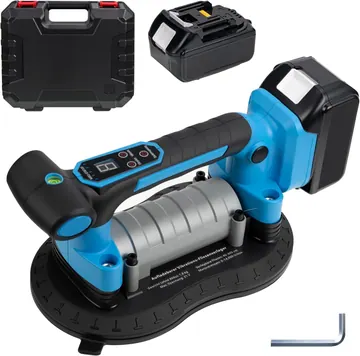
JUYLTOOL
JUYLTOOL tile vibrator with 25 cm suction cup for Makita 18 V
220 kgOvalRemovable battery
€94
Recommended models: Two batteries
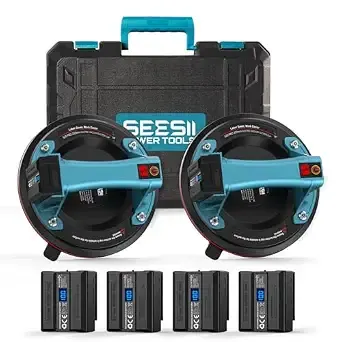
SEESII
SEESII battery vacuum gripper 203 mm, twin pack with 4 batteries
272 kgØ 203 mmRemovable battery
€43€22 each
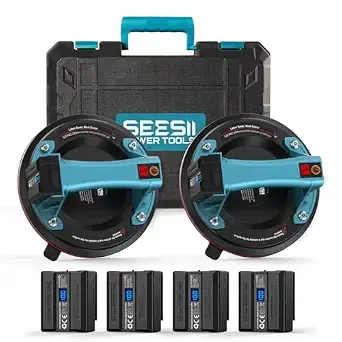
SEESII
SEESII electric 8-inch vacuum gripper, twin pack with 4 batteries
272 kgØ 203 mmRemovable battery
€43€22 each
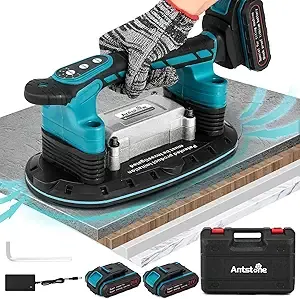
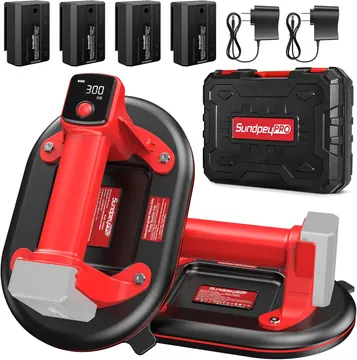
Sundpey
SundpeyPRO 10-inch battery vacuum lifter, twin pack, four 3 Ah batteries
300 kgOvalRemovable battery
€60€30 each